


How to Choose the Right Hearing Protection
Choosing hearing protection with an SNR higher than necessary can lead to over-attenuation, which means that conversation between people can be difficult to perceive. The same applies to warning signals, telephones and machinery noise. With correct and consistent use, you can achieve the expected attenuation stated on the packaging. The important thing is that hearing protection is worn at all times while in noisy environments and that, for example, an earplug fits the ear canal and is inserted correctly. In particularly high noise, we recommend hearing protection with a built-in radio. Hearing protection should fit snugly around the ear and the sealing rings should be inspected regularly. If they are hard or cracked, they must be replaced. REMEMBER! The most important thing is that the hearing protection is worn at all times.
EN standards for hearing protection:
EN 352-1 – Earmuffs
EN 352-2 – Earplugs
EN 352-3 – Helmet-mounted earmuffs
EN 352-4 – Level-dependent earmuffs
EN 352-5/A1:2006 – Earmuffs with active noise reduction
EN 352-6 – Earmuffs with audio communication
EN 352-7 – Level-dependent earplugs
EN 352-8 – Earmuffs for entertainment purposes
EN 458:2004 – Selection, use, care and maintenance
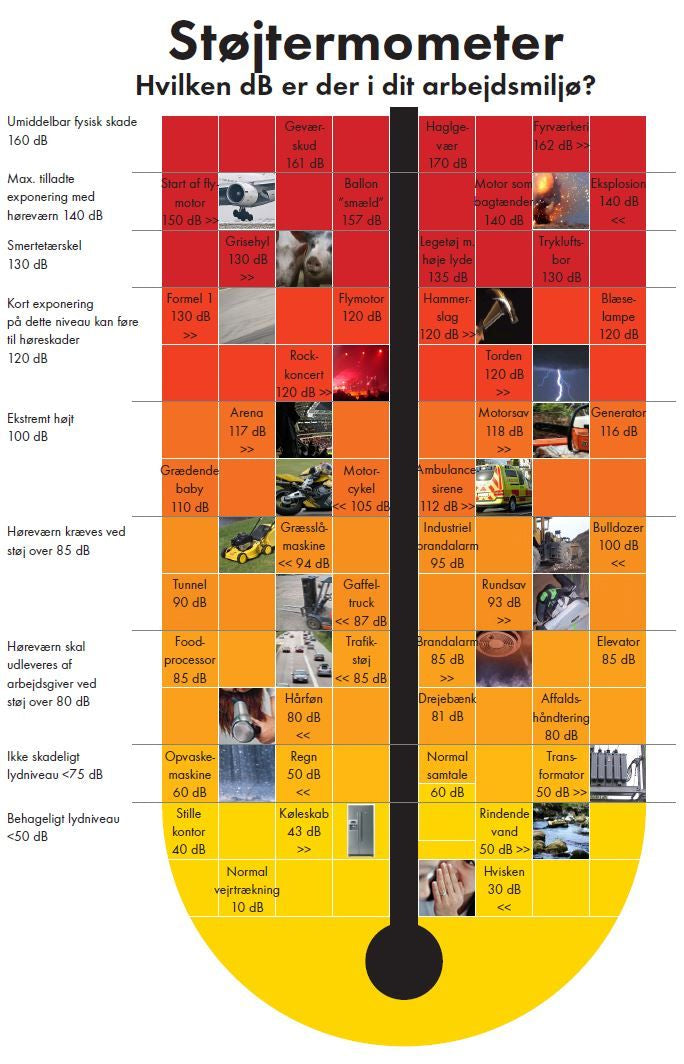
Sound level meter
Due to the EU's 2006 noise legislation, employers are required to provide appropriate hearing protection when noise levels exceed 80 dB(A).
All EU member states must comply with the new directive from February 2006. Prolonged exposure to noise levels above 80 dB(A) can lead to permanent hearing damage. Many employees who were not covered by earlier legislation are now required to wear hearing protection.
For example, workers in light industry and service occupations, as well as staff in bars and the public sector, may be exposed to excessive noise levels and therefore need suitable protection. If the noise level exceeds 95 dB, an accurate noise measurement must be made to select the optimal solution to the noise problem, e.g. hearing protection or noise reduction at the source.


